Your Body Is Not a Size: A Calmer Approach to Honest Measurements
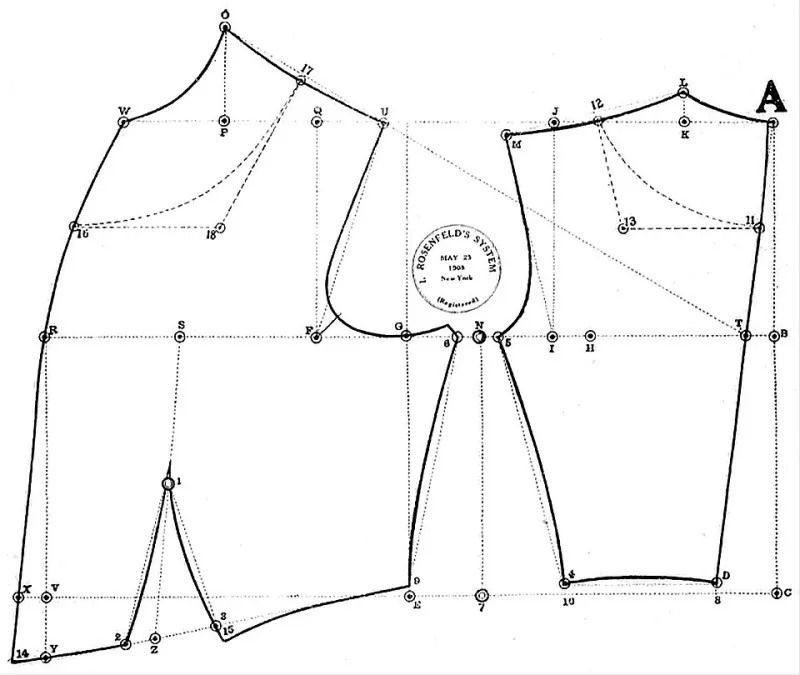
Photo: Isidor Rosenfeld, Public domain, via Wikimedia Commons
Before you cut into a length of good fabric, there is a quiet moment of negotiation. You hold the paper pattern against yourself, squint at the envelope, and decide which size to trace. For plenty of dressmakers, that decision is shaped less by a tape measure than by hope: the hope that this time we will make the version of ourselves we see in the illustration. It is a very human habit. It is also a slightly odd one. Clothes are meant to fit a person, not a fantasy.
At Bespoke Patterns, we are firmly in the camp of sewing the body you have. Not the body you had at twenty-one, not the body you are aiming for in January, and not the one the pattern envelope seems to admire. The body that gets up on a wet Tuesday, drinks tea, sits at a desk, carries shopping, and wants to be comfortable by four o'clock. That is the body worth drafting for.
The fantasy version in the mirror
Most of us have a fitting ghost. She is the size we wore at some golden moment, or the one we think we should be. She has a flat tummy and no need for a full bust adjustment. She is, frankly, exhausting.
Commercial sewing patterns do not help. A UK high street size 14 can be a pattern size 18, or a 16, or something in between depending on the brand and the decade. Pattern envelopes are drafted around body measurements, not shop labels. Choosing a pattern size by the number you buy on the high street is like choosing shoes by the colour of the box. It might work by accident, but it is not a system.
The more useful question is not 'what size am I?' but 'what are my measurements today, and what does this pattern need to know about them?' That is the whole basis of bespoke sewing. It is also much kinder.
Take the numbers without the story
Honest measurements are not a judgement. They are information. Put on the underwear you will actually wear under the finished garment, stand in front of a mirror, and tie a narrow piece of elastic around your natural waist. Breathe normally. Do not suck in, stand to attention, or hold the tape so tight that it leaves a mark.
Measure your full bust at the fullest point, then your high bust just above the bust and under the arms. Measure your waist at the elastic, your hips at the widest point, and add shoulder width, back length, and arm length if the pattern calls for them. Write the numbers down with the date. Ask a friend for the awkward ones. It takes ten minutes and saves a great deal of unpicking.
Two small rules help. Measure your body, not your favourite old jeans, because the jeans may have stretched or shrunk into a shape that is not you. And if you are between sizes, that is normal. Most of us are. A pattern is a starting point, not a verdict.
Fitting myths worth retiring
Myth one: you should pick a pattern size by your bust and hope the rest follows. In reality, many of us need to grade between sizes or make a full bust adjustment. That is not a failure of your body or your sewing. It is pattern work.
Myth two: if the finished garment feels roomy, you should have sized down. Ease is not emptiness. A shirt needs room to move, a coat needs room to layer, and a pair of trousers needs room to sit down in. Check the finished measurements on the pattern, not just the body measurements.
Myth three: a toile is a waste of time. A calico toile is one of the most useful things you can make. It lets you check the shoulder, the bust, the back, and the seat before you commit to the good stuff. It also gives you permission to make changes without feeling precious.
Myth four: an adjustment means the pattern is wrong. Patterns are drafted for a fit model, not for every body. A sway back adjustment, a full tummy adjustment, or a broad shoulder adjustment is simply a conversation between the pattern and you.
Calm adjustments, not punishing ones
Start with the high bust. It is often the most reliable guide for the upper body, especially if you have a fuller bust. From there, a full bust adjustment can add room where you need it without making the shoulders too wide. If you are smaller in the bust, a small bust adjustment can stop the fabric pooling.
Grade between sizes where it makes sense. You might be a 14 at the bust, a 16 at the waist, and an 18 at the hip. That is not a problem to solve; it is a line to draw on the pattern. Make one change at a time, toile it, and check it while seated, reaching forward, and climbing stairs. Clothes have to work in motion, not just in the mirror.
Keep a note of what you changed. A small fitting journal is worth its weight in gold. Next time you use the pattern, you will not be starting from scratch. That is the quiet luxury of bespoke patterns: they get to know you.
Sew for the life, not the label
The finished garment should fit the life it is made for. If you cycle to work, check the sleeve and shoulder room. If you spend the day at a desk, check the waistband when you sit. If you are layering a jumper underneath, make the toile with the jumper on. A dress that looks beautiful standing still but is miserable on the bus is not a successful make.
The best compliment a handmade garment can get is not 'what size is that?' but 'you look like yourself in that.' Sewing for the body you have is not a compromise. It is the whole point. Measure honestly, adjust calmly, and let the pattern serve the person wearing it.