Where You Actually Stand: A Posture Check Before You Cut
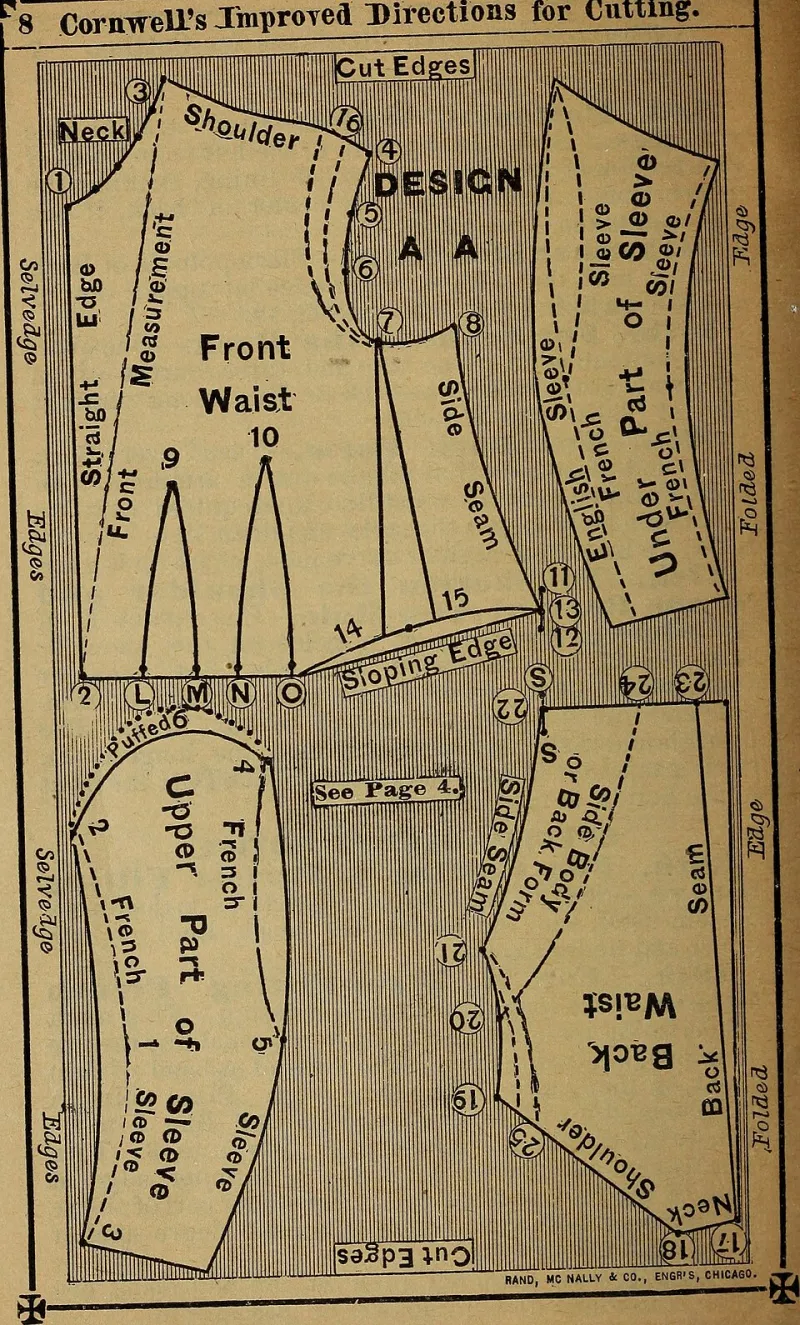
Photo: Internet Archive Book Images, No restrictions, via Wikimedia Commons
There is a quiet assumption built into most sewing patterns: that the body wearing the finished garment will stand in a neutral, symmetrical pose, arms slightly away from the sides, chin level, weight even. It is a useful starting point. It is also not how most of us spend a Tuesday.
At Bespoke Patterns, we are less interested in correcting your stance than in drafting for it. Real posture is a record of your life. The shoulder that curves forward from years at a keyboard. The lower back that softens when you are tired. The hip that hitches up when you carry a bag on one side. None of that is a fitting fault. It is information.
Before you cut into your good cloth, spend a little time noticing how you actually stand. Then make the pattern follow.
Start with a ten-minute standing check
You do not need a fitting buddy or a studio mirror. You need a phone, a wall, and a few minutes of not trying to stand properly.
Put on close-fitting clothes you can see your shape in. Stand side-on to a full-length mirror or prop your phone at hip height and take a photo from the side. Stand naturally. Do not pull your shoulders back or tuck your pelvis. Set a timer for three minutes and let yourself settle. The first pose is never the honest one; the third minute usually is.
Look for the broad shapes rather than tiny flaws. Is your head forward of your shoulders? Do your shoulders round towards the front? Does your lower back curve in sharply, with the pelvis tipped forward? Or is your pelvis tucked under and your upper back flatter than you expected? Are your knees locked? Is one shoulder noticeably higher?
Then take the check into the real world. Stand at your kitchen counter as if you are waiting for the kettle. Stand in a bus queue for five minutes, bag on your usual shoulder. Lean over your cutting table as if you are pinning a seam. Note what changes. The waistband that felt fine upright may dig in when you lean. The shoulder seam that looked neat in the mirror may slide back when you reach forward. That is the posture your pattern needs to accommodate.
Reading the usual suspects
A few standing habits come up again and again in fitting rooms, and each one leaves a recognisable clue in a calico toile.
Forward shoulders often show up as a shoulder seam that sits too far back, a back armhole that pulls, or a front bodice that feels tight across the chest even though the measurements say it should not. The body is asking for room in a different place.
A sway back, where the lower back curves in and the pelvis tips forward, tends to create a pool of excess fabric at the centre back waist. The hem may kick out at the back. The side seams may swing forward. The pattern is not too big overall; it is too long in one specific place.
Desk-bound hips and a rounded upper back are common companions. You may find the back neckline gapes, the shoulder seams slide towards the front, or the back rise of trousers feels short while the front feels generous. A body that spends its days seated does not necessarily want a seated pattern, but it often wants a little more length through the back and a slightly different shoulder angle.
Asymmetry deserves a mention too. Most of us are not perfectly even, and a dress form certainly is not. If one shoulder is higher, adjust for that shoulder and let the other side follow. Chasing perfect symmetry in a toile is often a waste of chalk.
The flat-pattern tweaks that help
You do not need to redraft the whole block. Small, targeted changes are usually enough, and they are easier to undo if they go wrong.
For forward shoulders, try a forward shoulder adjustment: slide the shoulder point forward by a centimetre or two, then true the armhole and shoulder seam. The aim is to put the seam where your shoulder actually sits, not where the pattern assumed it would.
For a sway back, pin a horizontal wedge out of the centre back of the toile, tapering to nothing at the side seams. Transfer that shape to the pattern as a shorter centre back length. Keep the side seams and front length as they are. This is a length correction, not a size correction.
For a rounded upper back, add a little length at the centre back neck and reshape the shoulder seam so it curves over the back rather than cutting across it. You may also need to scoop the back armhole slightly. Test in calico before committing.
For a fuller seat or a short back rise, add depth to the back crotch curve and a little width across the seat. For a tummy that needs room when you sit, adjust the front rise rather than sizing up the whole trouser. One change at a time, always on the toile.
Write every adjustment on the pattern piece in pencil. Date it. Note which toile it came from. Future you will be grateful.
Test the toile where you actually stand
A toile that behaves in front of the mirror can still fail at the kitchen counter. Once you have made your basic adjustments, put the toile back on with the shoes you will really wear and run through your day in miniature.
Stand at the counter and reach for the kettle. Sit on the edge of a chair and then stand up. Queue in the hallway with your bag on your shoulder. Lean over the cutting table and pin a hem. Check the shoulder seam, the armhole, the waistband, the back neck and the hem. Pin or chalk anything that pulls, gapes or rides up. Take photos from the side and back, because the mirror flatters and the camera does not.
If the toile twists when you lean, the pattern needs a different grain or a little more room in the back. If the waistband gaps when you stand, the back rise or the curve needs attention. If the hem swings forward in the queue, check the balance of the skirt or trouser leg. These are not failures. They are the useful bits.
When to stop adjusting
A pattern is not a posture correction device. Your body will change from morning to evening, from summer to winter, from one pair of shoes to another. The goal is a garment that feels like yours in the places you actually stand, not a garment that locks you into a pose.
So leave a little room for slouch. Leave room for a jumper underneath. Leave room for the days when you carry too much and stand badly. The dress form can keep its perfect posture. Your pattern should fit the person at the counter, in the queue and at the cutting table.