The Six-Forty Fumble: Drafting Winter Clothes You Can Dress Into by Feel
There is a particular kind of November morning in the UK that seems designed to make getting dressed harder than it should be. The heating is still clicking itself awake, the window is a slab of blue-black, and you are standing in front of the wardrobe trying to work out which way round the wool trousers go. You are not fully awake. You may be holding a mug. And yet the clothes still have to go on, in the right order, without a fight.
Most sewing advice assumes good light and a mirror. Winter dressing often happens in neither. That is not a niche problem — it is the daily reality for anyone leaving the house before seven, coming home after five, or sharing a bedroom with someone who is still asleep. The good news is that this is exactly the sort of thing a bespoke pattern can solve, if you draft for the hand as well as the eye.
Design for the hand, not just the mirror
When you are drafting a winter garment, think about the information your fingers need. A front opening should be findable by touch. An armhole should have a clear right and wrong side. A label should tell you which way is up without scratching your neck.
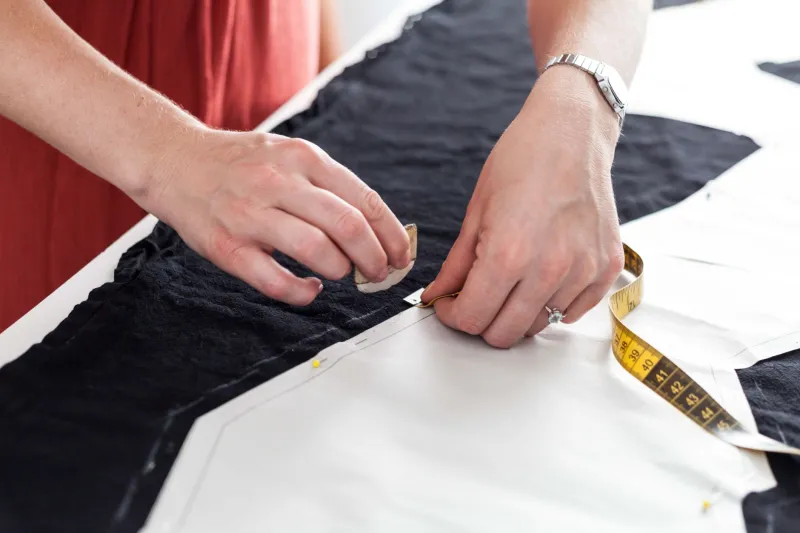
This is where seam finishes start earning their keep. A contrast binding inside a dark wool coat is not just a pretty secret — it is a map. Run your thumb along the inside front edge and the binding tells you where the buttonhole placket begins. Flat-felled seams give a distinct ridge you can follow down a sleeve. French seams feel smooth and directional. Even the choice between a plain seam and a bound one becomes a design decision when half your dressing happens in the dark.
Labels are the other quiet hero. A looped tag — a small folded ribbon rather than a flat woven label — is easier to find and less likely to irritate. Put one at the centre back neck, and consider a second at the back waistband of trousers or a skirt. If you are making a unisex or shared pattern, a small coloured thread mark at the back neck is a cheap, invisible cue that survives the wash.
Fastenings that announce themselves
A winter coat with tiny, identical, smooth buttons is a beautiful thing in daylight and a small nightmare at 6:40am. You do not need novelty fastenings; you need differentiation.
Try a larger button at the neck and smaller ones below, or a textured corozo button that feels different from a smooth horn one. A zip pull with a short ribbon or a leather tab is easy to locate by feel and easy to grip with cold fingers. Toggles are excellent for thick wool because they are big, quiet and forgiving. Snaps are quick, but check they are strong enough not to pop open when you reach for a handrail. Avoid tiny hook-and-eye closures at the neckline of a winter piece unless you have very good reason — they are fiddly in gloves and invisible in low light.
The rule is secure but simple. One hand should be able to do most of it. If you need to look down and use both hands and a mirror to fasten a cuff, the cuff will stay unfastened on the commute.
Let linings do the sliding
A lot of winter dressing frustration is friction. Wool on wool, brushed cotton on brushed cotton, a sleeve lining that has twisted in the wash — all of it turns a simple action into a wrestle.
A smooth lining in a sleeve is worth the extra half-metre. Bemberg or cupro feels lovely and slides easily over a jumper; a good quality polyester lining is cheaper and perfectly serviceable. In trousers, a half-lining to the knee can make the difference between stepping in cleanly and hopping about on one leg. If you are drafting for someone who wears thermal layers, test the toile over the thickest base layer they own, not a thin summer one.
Also think about the inside of the garment where it meets the body. A lined bodice in a coat or gilet helps the whole thing rotate as you put it on. Smooth seam allowances, rather than scratchy overlocked edges, make a surprising difference when you are pulling a sleeve up your arm in the dark.
The eyes-closed wear test
Before you commit to the final cloth, make the toile earn its keep. This is a simple test you can do at the kitchen table with the lights off or your eyes closed. It takes about ten minutes and it will tell you more than a mirror ever will.
- Put the toile on the table in a jumble — not neatly laid out.
- Close your eyes, or turn the lights off, and pick it up.
- Find the front, the back, the armholes and the fastenings by touch alone.
- Put it on, fasten it, adjust the collar and cuffs, then take it off again.
- Repeat once more, seated, as if you were on a train or in a car.
Afterwards, open your eyes and note where you hesitated. Was the back neck hard to find? Did the sleeve lining bunch? Did you fasten the buttons in the wrong order? Mark those points on the toile with a pin or a scrap of tape. Those are the places to add a loop tag, change a button, or adjust a seam finish.
It is worth doing this test twice — once with the toile as drafted, and once with a rough lining pinned into the sleeves. The difference is often more revealing than any fitting adjustment.
What to change on the pattern
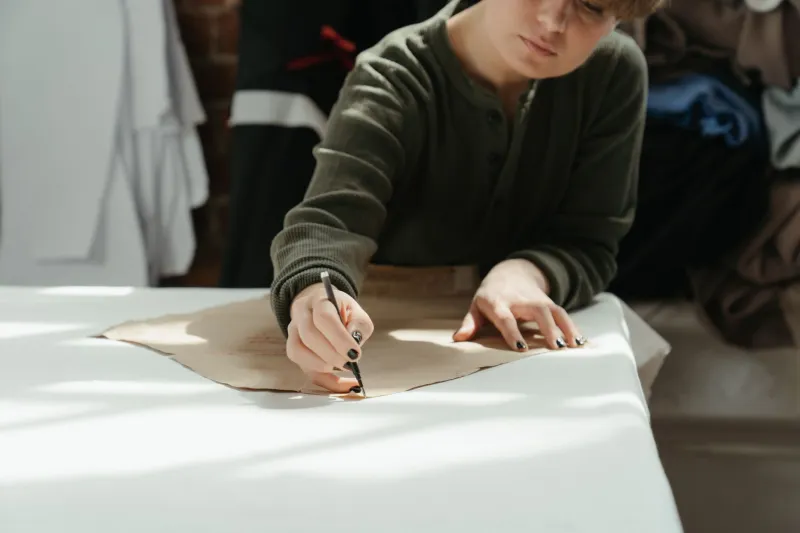
Once you have your list, transfer the fixes back to the pattern pieces. Add a loop-tag placement notch at the back neck. Note the contrast binding on the inside front edge. Mark the button positions in a way that makes the top one deliberately different. If you are drafting a coat, decide now whether the lining will be bagged out or hand-finished at the hem, because that affects how the inside feels when you push your arm through.
And keep a small note on the pattern envelope: ‘dark morning test done’. It sounds fussy. It is not. It is the difference between a garment you wear and a garment you avoid because it is too much effort before coffee.
Bespoke patterns are supposed to fit real life, and real life in a British winter is often dark, cold and slightly rushed. Draft for the hand that finds the button, the arm that finds the sleeve, and the person who would rather not turn the light on. Your future self, fumbling at the front door at ten to seven, will thank you.