Hemlines That Earn Their Keep: Drafting Party Clothes Around the Shoes You’ll Actually Wear
There is a particular kind of disappointment that comes from finishing a party dress, trying it on with the shoes you actually own, and discovering the hem is doing something entirely different from the plan. Maybe it grazes the floor in bare feet and then hovers awkwardly over a heel. Maybe the trousers look sharp with flats but pool around a pair of dance-floor sandals. Maybe the skirt catches the top of your boots every time you climb a stair. Bespoke patterns give us a wonderful excuse to avoid all that — but only if we draft around the shoes, not the idea of the shoes.
Start With the Shoe, Not the Sketch
Most of us sketch or pick a pattern first, then think about footwear somewhere near the end. For party clothes, it pays to flip that. The shoe changes your posture, your leg length and the way a hem falls. A 7cm heel does not simply make you taller; it tilts the pelvis, changes the break at the knee and alters where a skirt sits against the calf. A chunky boot shaft changes the silhouette of a midi skirt. A pointed toe can make a wide trouser leg look deliberate; a round toe can make the same hem look as though it is waiting for something to happen.
So before you cut, put the intended shoes on the table. Not a similar pair. The actual pair. Measure the heel height, including any platform, and note the toe shape. If you are drafting a skirt or dress, check where the top of any boot shaft lands on your leg. If you are making trousers, look at the shoe’s width and toe length — that is the shape your hem has to negotiate.
The Shoe-On Toile Test
A toile is your best chance to see the truth without risking the good cloth. Wear the shoes you plan to wear, plus the tights, socks or insoles you will really use. Party outfits often involve a slightly different underlayer from everyday clothes, and a few millimetres of cushioning or a thicker tight can change the fit.
Pin the hem in place while standing in the shoes. Then do more than stand. Walk across the room, climb a flight of stairs, sit down, cross your legs, and do a few unguarded dance steps. If you can, walk up and down a step or a low box — this is the closest you will get to a bus step, a pub threshold or the edge of a dance floor without leaving the house. Watch for three things: the front hem clearing the floor, the back hem not dragging, and the whole thing staying clear of the shoe in motion.
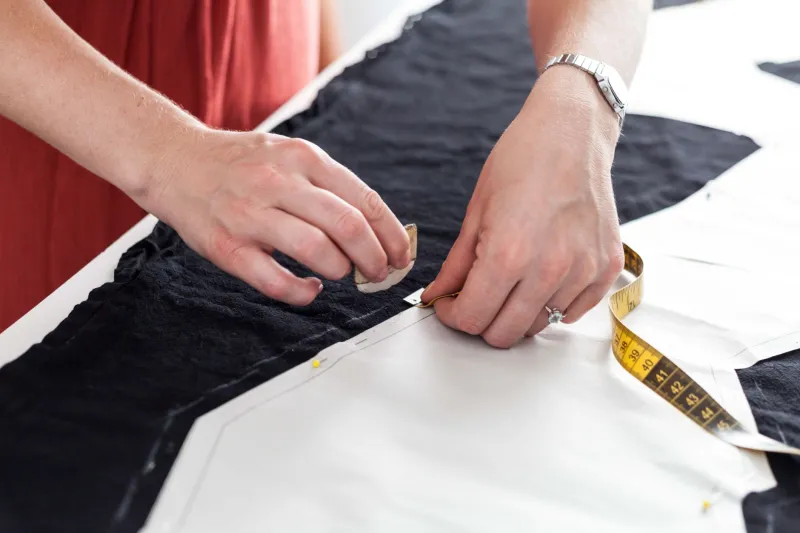
Mark the hem with tailor’s chalk while the toile is on and the shoes are on. It is tempting to pin in front of a mirror and call it done, but the mirror flatters a static pose. The real test is movement.
Heel Height and the Hem Equation
A common mistake is to hem a dress to the floor in bare feet, then add heels and find it has become a different garment. If you know you will wear heels, hem in the heels. If you might switch to flats halfway through the night — and many of us do — decide which version gets priority. A hem that works with both is usually a little shorter than the floor-skimming ideal. For a full-length dress, aim for a slight clearance at the front when you are in the higher shoe; that same hem will often sit just off the floor in flats without looking wrong.
For trousers, the shoe changes the break. With a heel, you may want a clean, almost floating hem that just touches the instep. With flats, you may need a little more length so the trouser does not look chopped. If you are between the two, a modest break and a slightly narrower hem opening can work with both. Always check the back hem in the shoes: it should not sit so low that it scuffs along the pavement or catches under your heel.
Boots, Shafts and the Tricky Mid-Calf
Party season is boot season, and boot shafts deserve their own fitting check. A midi skirt that looks lovely with bare legs can suddenly look busy when it meets the top of a knee-high boot. This is not automatically a problem — overlap can look intentional and elegant — but it needs to be deliberate. Put on the boots with the toile and check the gap or overlap. If the skirt hem sits exactly at the boot top, it will likely shift and catch as you walk. Give it a clear overlap or a clear gap.
For trousers, check that the boot shaft fits inside the hem without dragging. If the trouser is narrow, you may need a slightly wider opening or a small side vent. For skirts, check that the hem clears the boot when you sit and climb stairs. A close-fitting pencil skirt with a tall boot can be a beautiful combination, but it needs a walking vent or a little extra room at the back to avoid the hem riding up.
Dancing, Pub Crawls and the Last Bus Home
Party clothes have to survive more than a photograph. A dance floor asks for hem clearance, secure fastenings and a bit of swing. A pub crawl asks for hems that do not trail over sticky floors or catch on bar stools. Public transport asks for a hem that can cope with steps, escalators and the awkward shuffle of a crowded carriage. None of this means dressing defensively; it means drafting intelligently.
If you are making a full skirt, test it with a few turns and a simple step-together-step. If the hem swings out and stays out, fine. If it wraps around your legs, you may want a little more width or a slightly shorter length. For trousers, sit on a low stool and cross your legs. The hem should not climb so far that the shoe disappears, and it should not drag on the floor when you stand up. For anything long, consider a hidden hem weight or a small horsehair braid in the hem to help it fall cleanly without making it stiff.
The Office Party to Last Train Adjustment
Office parties often involve a journey: desk to venue, venue to bar, bar to station. If you are wearing the same shoes throughout, draft for the longest walk and the most stairs, not just the venue. If you are changing shoes, make the change part of the plan. A slightly shorter hem in the day shoe and a slightly longer one in the evening shoe is easier to manage than a hem that relies on you standing still all night.
A small back vent or a slightly raised front hem can make a real difference on stairs. Test it on a real staircase, not just a mirror. If you can, wear the toile and shoes to the top of a flight and walk down normally. A hem that trips you is not a hem that earns its place.
The Final Checklist
Before you commit the good fabric, put the shoes on and run through this: walk twenty steps, climb one flight, sit down, cross your legs, do a simple turn, and check the hem in a mirror from the back. Make sure the front clears the floor, the back does not drag, the hem clears any boot shaft, and the trousers sit over the shoe without collapsing. Then ask the practical question: can you get on a bus, climb a pub step and dance without thinking about your hem? If the answer is yes, the pattern is doing its job. That is bespoke dressing at its best — not just made to measure, but made for the night you actually have planned.