Room to Breathe, Room to Clip: Drafting Clothes Around Everyday Medical Kit
Most sewing advice starts with the body. Fair enough. But for anyone living with an insulin pump, a port or an ostomy bag, the garment has a second job: it needs to make room for kit without turning every outfit into a statement. That is not a niche problem. It is a fitting problem, and fitting is exactly where bespoke patterns earn their keep.
At Bespoke Patterns, we are not medics and we are not pretending otherwise. Check any access needs with your healthcare team first. What we can do is talk dressmaking: where to put a pocket so it is reachable but not obvious, how to choose an opening that lies flat, and why a calico toile is still the most honest test you can give a pattern.
Start with the kit, not the size chart
Before you trace a single pattern piece, make a short list of what the garment has to accommodate. A pump clipped to a waistband has different needs from one tucked into a soft pocket. A port sits still, so you need clearance rather than movement. An ostomy bag needs room to fill and a route to empty without dismantling your outfit in a public loo.
Write down three things: where the device sits on your body, how often you need to reach it, and what you usually wear over it. Then measure the device itself, including any tubing or clips. This is not about making the garment enormous. It is about knowing where to add a little ease and where to leave the line clean.
If you are sewing for a friend, ask them to bring the actual kit to the fitting. A cardboard stand-in is fine for a first toile, but the real thing tells you far more. Let them show you how they reach for it. The movement is the measurement.
Pockets that do not announce themselves
A discreet access pocket is usually a pocket that does not look like an access pocket. On trousers, a side seam pocket can be deepened and given a soft, stretchy lining so a pump sits flat against the thigh. On a dress or tunic, a pocket set into the side seam or a princess seam can be reached through a normal-looking opening. The trick is to keep the pocket mouth in line with an existing seam so the eye reads it as construction, not adaptation.
For ports, think about a horizontal opening rather than a vertical one. A short, faced slit placed just below the collarbone can be covered by a collar or a scarf and still give clear access. On an ostomy bag, a pocket is often less useful than a well-placed opening. A curved placket or a soft flap in the front of a garment can provide coverage without bulk, especially if the fabric returns to the body gently rather than standing away.
Do not forget the inside. A raw pocket bag will rub. Use a lightweight cotton or a soft mesh for the lining, and finish the seams so nothing scratches. If the pocket needs to hold weight, interface the mouth lightly but leave the bag free.
Openings and seams that behave
A zip is not always the answer. For pump access, a simple vertical opening with a hidden press stud or a hook-and-loop tab can be quicker and flatter than a zip. For ostomy access, a flap that opens from the side or bottom often works better than one that opens from the top, because it lets you reach without pulling the whole garment up.
Look at your seams as potential doors. A side seam can hide an opening. A raglan seam can be left open for a few centimetres and finished with a narrow facing. A centre-front seam can become a soft placket. The aim is to make the opening part of the garment's architecture, not something tacked on afterwards.
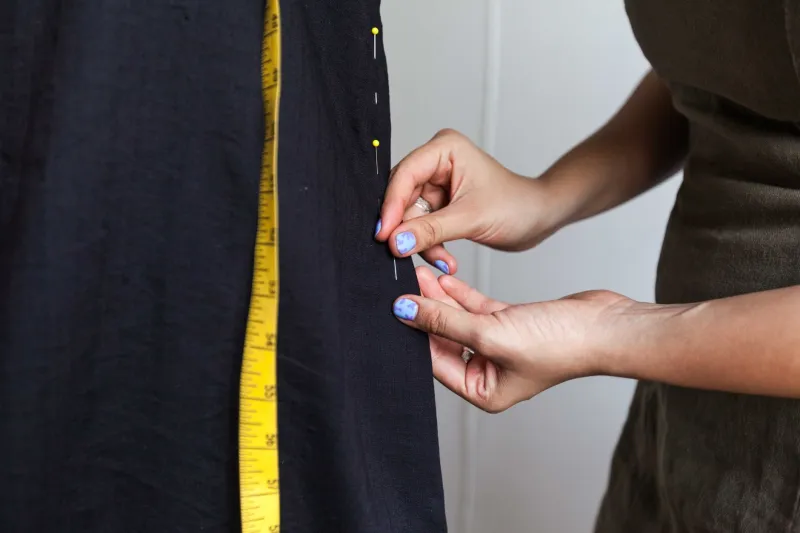
One warning from the sewing room: openings need to lie flat when closed. Test this on the toile. If the flap curls or the seam gapes, try a lighter interfacing, a smaller opening or a different fastening. A press stud is often calmer than a button, and a strip of soft elastic can keep a flap sitting neatly without hard edges.
The toile is the rehearsal
You would not rehearse a play without saying the lines. Do not test an access adaptation without the device. Make a calico toile, mark the proposed opening, and then try the whole routine: sit down, stand up, reach for the pump, empty the bag, check the port. Do it in the clothes you would actually wear, not just in your sewing room.
This is where a toile earns its reputation. It will show you if the pocket is too high, if the opening twists when you sit, or if the fabric pulls across the device. It will also show you whether the garment still looks like you. That matters. Adaptations should not make you feel like a walking medical accessory.
If you are working with a bespoke pattern, keep the toile. Write notes directly on it with a fabric marker. A second toile is not a failure; it is a fitting tool. And if the first attempt feels fussy, simplify. One well-placed opening is worth three clever ones that you never use.
Fabric that keeps the line smooth
Fabric choice does a lot of quiet work here. A medium-weight woven with a bit of body, such as a cotton twill, a soft linen blend or a ponte, will skim over a device better than a thin jersey that clings. For openings, choose a fabric that presses well and does not fray the moment you look at it. For pocket linings, choose something soft and light.
Pattern matters too. A busy print hides small bulges and seam lines. A dark solid shows every lump. That does not mean you should avoid plain fabrics, but it does mean you should toile in a similar weight and colour if you can. A cream calico will always look smoother than a black crepe.
And think about the British weather. A garment that works with a pump under a jumper may need a lighter layer for summer. A coat with a discreet inside pocket can be a godsend in winter, and a soft scarf can cover a port opening without looking like camouflage.
Sewing for someone else
If you are making for a friend, let them lead. Ask where they want access, not where you think it should go. Some people want a pocket they can reach without looking. Others want an opening they can use in a bathroom without undressing. Both are valid.
Keep the language ordinary. No one wants to be described as a project. Say you are drafting a pocket for their pump, or an opening for their bag, and then get on with it. The best compliment a bespoke garment can receive is that it feels like clothes, not equipment.
A final check before the shears
Before you cut the good fabric, run through this list: the device fits, the opening closes flat, the pocket is reachable, the seams are smooth against skin, and the garment still looks like something you would choose in a shop. If any answer is no, go back to the toile. That is not a delay. That is the whole point of bespoke.
Clothes should make daily life easier, not more complicated. With a little thought at the pattern stage, a garment can hold a pump, clear a port or cover a bag without making a performance of it. That is not medical sewing. That is just good dressmaking.