Necklines That Stay Put: A Movement-First Guide to Bodice Drafting
There is a particular moment of betrayal in dressmaking. You finish a bodice toile, stand in front of the mirror, and everything sits beautifully. Then you reach for the kettle, bend to pick up a pin, or sling a bag over your shoulder — and the neckline makes a break for it. It is not a failure of your sewing. It is a failure of testing. A bodice pattern has to survive real movement, not just a still pose, and that is especially true in a British wardrobe full of layers, commutes and weather that changes its mind by lunchtime.
Start with the movements, not the mirror
Before you study the neckline in the mirror, put the toile through a short movement audit. Wear the same undergarments you plan to wear with the finished garment, and add the layers you realistically expect: a fine jumper, a cardigan, a coat over the top if that is how you will wear it. Then run through the following:
- Reach both arms overhead, as if lifting a bag into an overhead rack or hanging washing.
- Bend forward to tie a shoe or pick something up from the floor.
- Lean over a desk, a kitchen counter or a bus seat to read or work.
- Carry a shoulder bag, then a rucksack, and notice whether the strap drags the neckline sideways.
- Sit down, cross your arms and twist to look over your shoulder.
- Put on and take off a scarf and a coat.
You are not looking for perfection in every pose. You are looking for the places where the neckline lifts, bows away from the body or pulls the shoulder seam out of place. Mark those spots with tailor’s chalk as you go. A phone propped on a shelf can be surprisingly useful here, because the back neckline is hard to judge by feel alone.
Why a neckline gaps in the first place
A gape is rarely one thing. It can come from a back neckline that is too wide or too straight for your shape, a shoulder slope that the pattern has not accounted for, a facing that is too narrow to support the edge, or dart placement that pulls the bodice in one direction when you move. Fabric matters too: a crisp cotton holds a shaped neckline better than a fluid viscose, and a bias-cut edge will behave differently from one cut on grain.
Posture plays its part. If you stand with rounded shoulders, a back neckline drafted for a very upright figure will stand away from the body. If you have a fuller bust, a neckline that has not been adjusted at the bust can tilt forward. None of this means your body is wrong. It means the pattern needs a conversation with your movement.
The five-minute toile audit
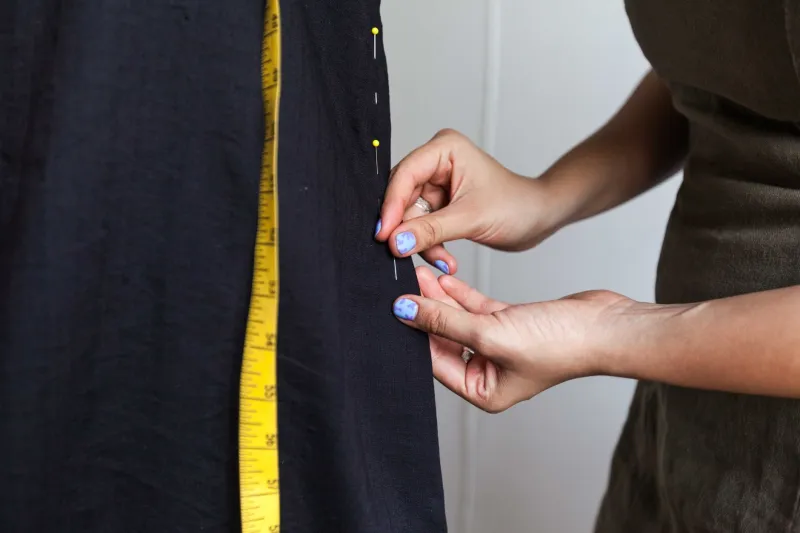
Once you have marked the problem areas, pinch out the excess on the toile and pin it. Do not worry about neatness yet. At the back neck, pinch vertically and diagonally to see whether the gap closes with a deeper curve or with less width. At the front, check whether the gape appears when you reach upwards; if it does, the issue may be shoulder or dart related rather than the neckline itself.
A useful rule of thumb: if the gap is small — roughly a centimetre or so — you can often solve it with a facing tweak or a stay. If it is larger, or if the shoulder seam shifts when you move, go back to the pattern and redraft the back neck and shoulder area. Pinning a quick fix over a fundamental draft problem rarely survives a second wear.
Back-neck shaping: the quiet fix
A back neckline that is too straight is a common culprit. Most backs are not flat planes; they curve gently from shoulder to shoulder. Deepening the back-neck curve slightly and reducing the width at the centre back can make a remarkable difference. On a bespoke pattern, you can also add a centre-back seam if it suits the design, which gives you more control over the curve and makes future adjustments easier.
If the toile tells you the back neck is fine at rest but lifts when you reach forward, the problem may be that the neckline has no support. That is where facings and stays come in.
Facings that hold their ground
A facing is not just a tidy edge. It is structure. A narrow facing on a floppy fabric will curl and wave; a shaped facing with a lightweight interfacing will hold the neckline in place. Cut the facing to follow the neckline curve exactly, interface it according to the fabric, and understitch it so it rolls to the inside. A staystitch just inside the seam line before you attach the facing can also stop the edge stretching out of shape.
For extra security, catchstitch the facing to the inside of the bodice at the shoulder seams and centre back. This stops the facing from flipping out when you move, and it is far less fussy than it sounds.
Tiny stays, big difference
Shoulder stays and back-neck stays are small strips of tape, ribbon or silk organza sewn into the seam allowances. They take minutes to add and can transform how a neckline behaves. A stay across the back neck, anchored at the shoulder seams, gives the edge something to hold on to. A shoulder stay prevents the shoulder seam from stretching when you carry a bag or reach overhead.
On a bespoke pattern, you can build these into the construction notes so you do not forget them on the final make. It is the kind of detail that makes a handmade garment feel quietly reliable.
Dart placement and the reach factor
Darts do more than shape the bust. They influence how the whole bodice moves. If a bust dart is placed too high or too low, the neckline can tilt forward when you reach. If a shoulder dart is too long, it can pull the shoulder seam and create a gap at the front neck. Test dart positions on the toile with pins and move them in small increments. A full bust adjustment may also reduce neckline gape, because it gives the bodice the room it needs to sit down against the body rather than riding forward.
Layer for the forecast, not the fantasy
A neckline that works over a silk camisole may not work over a wool jumper and a winter coat. Test the toile with the layers you actually wear. Check whether a scarf pushes the neckline out of shape, whether a coat collar interferes with the back neck, and whether a bag strap catches the edge. On public transport, you will reach, twist and lean far more than you do in front of a mirror, so the toile should be tested in those positions too.
When to tweak, and when to redraft
Tweaks are for small gaps and support issues: a stay, a shaped facing, a slightly deeper back-neck curve. Redrafting is for shoulder slope changes, significant width problems or a neckline that consistently lifts when you move. Be honest with the toile. It is far easier to redraw a pattern line than to unpick a finished bodice.
The best bespoke patterns are not just drafted to your measurements. They are drafted to your reach, your layers and your daily life. A neckline that stays put through the school run, the office desk and the bus home is a small victory, but it is the kind of victory you feel every time you wear the garment.